
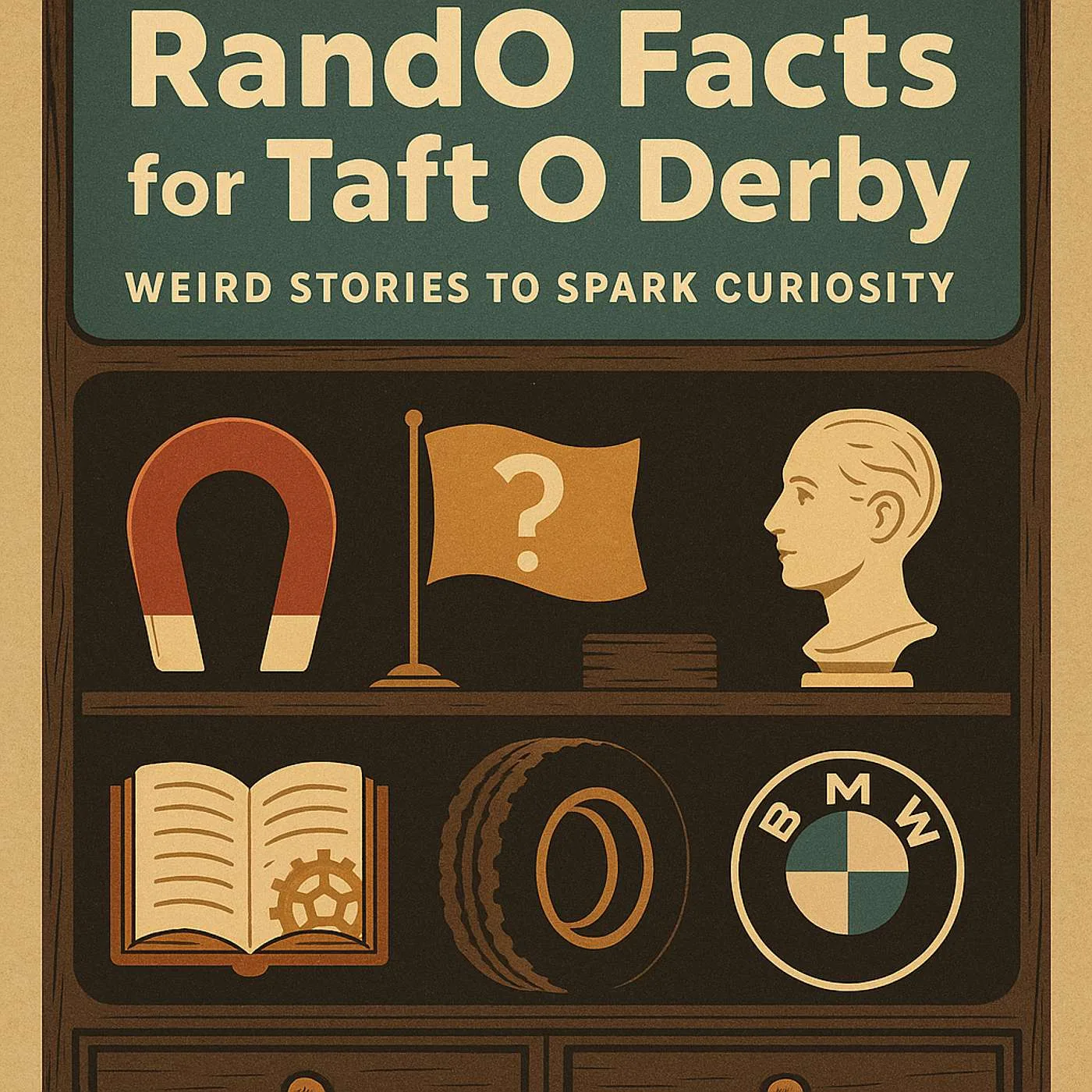
RandO Facts for Taft O. Derby
Dr. Mel Brown
A collection of audio episodes where Dr. Mel Brown (Mom) tells Taft weird, true stories about things that don't make it into textbooks. Each episode picks a theme—strange jobs, wars over stupid reasons, animals that broke science—and unpacks 4-5 stories that sound fake but aren't.Started because of that two-hour car ride back from Logan where we went from discriminant AI to Michelin stars to the Korean War with no map between them. This is that conversation, extended. Some episodes will drop daily. Some weekly. Some whenever there's a good theme worth chasing.No fluff. No listicles. Just: here...
Episodes
Epic Firsts
This episode explores the concept of "Epic Firsts": historical breakthroughs that arrived not as polished milestones, but as messy, barely functional experiments that defied the logic of their time. It argues that these moments serve as "permission slips" for progress rather than finished products, drawing parallels between three historical innovations and modern technological disruptions. Let's see what the world's been hiding.
Why AI Hallucinations Are Modern Phlogiston
Does AI actually reason, or is that just a modern myth like 18th-century Phlogiston? This episode explores how we overlook hallucinations and brittle patterns because the "reasoning" metaphor feels elegant. Join us to discuss why true progress requires abandoning "good enough" theories and demanding measurement that is sharper than marketing. Let's see what the world's been hiding.
Disasters Exactly as Predicted: The Warnings We Archive and Ignore
Radium that glowed in the dark. Lead that stopped engines from knocking. Teflon that made everything slide off. They solved real problems. Then decades later, we found them in everyone's blood. This episode covers the substances we thought were miracles until we realized they don't break down, don't leave, and accumulate forever. The gap between "this works" and "this kills you slowly" turns out to be about fifty years. By the time we figured it out, it was already everywhere.Content NoticeThis episode discusses toxic chemical exposure, occupational deaths, and corporate negligence. Treatment is factual and investigative, not graphic. Let's see what the world's been hiding.
The Parking Lot Paradox: Why Starting Is Harder Than Doing
David Goggins sat in his truck for a week outside a Navy recruiting office, too afraid to walk in. Not because he didn't want to be a SEAL—because finding out he couldn't would destroy the dream. A story about the ten steps that changed everything, and why the parking lot was harder than Hell Week.Content NoticeThis episode discusses weight loss, intense physical training, and military selection processes. Contains references to depression and self-doubt. Presents honest but encouraging perspective on overcoming fear of failure. Let's see what the world's been hiding.
The Bridge Nobody Saw Coming: A Story About Invisible Work
A young builder carries stones across a canyon one by one while everyone mocks him. For months, it looks like nothing—just pointless rocks jutting into air. Until the day it suddenly reaches the other side. A parable about the invisible work that doesn't look like progress until it does.Content NoticeThis episode explores themes of working without recognition, sustaining effort through mockery, and the loneliness of building something others can't see yet. Encouraging and affirming about long-term dedication. Let's see what the world's been hiding.
Normalization of Disaster: When Small Errors Cascade into Catastrophe
A misplaced decimal point. An ambiguous phrase. A decision to save money on rivets. Five disasters where a single small mistake cascaded into tragedy—from the Challenger explosion to a Mars mission lost over units. These aren't stories about bad people, but about how fragile complex systems really are when one detail goes wrong.Content NoticeThis episode discusses fatal disasters including the Challenger explosion, aviation accidents, and the Titanic sinking. Contains descriptions of engineering failures that resulted in loss of life. Presented factually without graphic detail, focusing on the cascade of decisions rather than the human toll. Let's see what the world's been hiding.
Three Times Everyone Fell For It: History's Hoaxes & Human Gullibility
In 1912, scientists believed they'd found the missing link between apes and humans. Forty years later, someone noticed the jaw was filed down and stained with tea. In 1869, workers dug up a 10-foot stone man in upstate New York—newspapers called it proof of biblical giants. It was carved in a barn the year before. In 1938, Orson Welles read a radio script and convinced America that Martians had landed in New Jersey. This episode covers hoaxes so good they fooled experts, made fortunes, and revealed how badly people want to believe something extraordinary. Content NoticeThis episode discusses historical hoaxes and public panic events. Treatment is analytical and historical and focuses on human psychology and institutional failures rather than mocking victims of deception. Let's see what the world's been hiding.
Engineering Brilliance: The Fine Line Between Prank and Crime
Epic (and illegal) college pranks that demanded advanced engineering degrees, weeks of planning, and cross-country logistics. We look at feats requiring custom equipment to steal a 1.7-ton cannon and complex assembly to build a police car replica atop a massive dome. These stories reveal what happens when brilliant, unsupervised minds choose hilarity over homework, proving that the greatest challenge is often the joke itself.Content NoticeThis episode discusses technically illegal activities undertaken as pranks, including theft of property (The Caltech Cannon Heist), breaking and entering, public disruption, and a hoax involving claims of building a nuclear reactor which crossed into a public safety concern (The MIT "Reactor" Prank). The content is framed within the context of historical college traditions and engineering challenges. Let's see what the world's been hiding.
No Turkey, No Pie, No Invitation : Unpacking the Harvest
Today we dive into the true roots of Thanksgiving, a holiday ranked second only to Christmas. The rosy story taught in school leaves out crucial details. We ask: Why wasn't turkey even on the menu, and what exactly brought the Wampanoag tribe to the Pilgrims' harvest festival? This rabbit hole uncovers the controversial history and long-held myths, examining why the accepted narrative obscures the brutal truths of early colonial history.Content NoticeThis episode discusses the real history of Thanksgiving, focusing on controversial aspects and dark historical facts that differ from grade-school narratives. Topics include the whitewashing of history, the concept of Manifest Destiny, the bloody conflicts between settlers and Native Americans, including massacres, death from disease brought by colonizers, and the capture and selling of Native Americans into slaver Let's see what the world's been hiding.
When Everyone Lost Their Minds: History's Strangest Mass Manias
Flower bulbs traded for houses. A man sat on a pole for weeks while crowds watched. Hundreds danced in the streets until they died. Stuffed animals became retirement plans. A prophecy sent people fleeing to mountaintops with homemade boats. This episode covers the moments when mass delusion took over—not because people were stupid, but because social pressure and fear of missing out override everything else. It all sounds ridiculous now. It felt inevitable then.Content NoticeThis episode discusses mass hysteria events and economic bubbles. Treatment is historical and analytical. Let's see what the world's been hiding.
From Battlefield to Kitchen: Accidental Inventions Born of Necessity
A contest to feed Napoleon's army created the canning industry. Engineers trying to survive nuclear war accidentally invented the internet. A submarine navigation system became GPS. A messy lab bench saved millions from infection. A melted chocolate bar led to the microwave. This episode covers inventions nobody planned—solutions to specific problems that ended up solving problems nobody knew existed. Sometimes the best innovations come from noticing what wasn't supposed to happen.Content NoticeThis episode discusses military technology development and wartime applications. Treatment is historical and analytical. Let's see what the world's been hiding.
Banned: Ridiculous Laws Born from Bureacracy
Let's explore a catalog of prohibitions imposed by governments convinced they were protecting citizens. Why were common recreational games, popular foods enjoyed globally, specific colors, and even reference books deemed illegal? We trace the moral panics that led to restrictions lasting decades, revealing a structural failure: the ease with which fun things are banned compared to the difficulty of regulating profitable dangers.Content NoticeThis episode discusses historical legal restrictions surrounding moral panics, including accusations of organized crime (Pinball) and laws initially targeting prostitution (Japanese dance ban). It also references censorship and "objectionable" words like "knock up" and "ball" in the discussion of dictionary bans. Let's see what the world's been hiding.
Seven Presidents in 55 Years: Ohio's Strange Political Dynasty
Taft, your namesake hated being president. Fell asleep in meetings, gained 100 pounds, called it "the loneliest place in the world." Then became Chief Justice and was genuinely happy for the first time in decades. Between 1868 and 1923, Ohio produced seven presidents through pure political machinery—swing state math, party bosses, and electability over vision. Then Harding's corruption killed it. This episode covers how a state became a presidential factory, why Taft's redemption story matters, and why the whole system collapsed.Content NoticeThis episode discusses political corruption, including bribery, embezzlement, and the Teapot Dome scandal. Treatment is historical and analytical, not graphic. Let's see what the world's been hiding.
Too Weird to Be Real: When Nature Broke the Rulebook
George Shaw took scissors to the first platypus specimen in 1798—not to dissect it, but to check for stitches. It looked too wrong to be real. The bombardier beetle shoots boiling chemicals from a rotating turret. The mantis shrimp punches so fast it creates temperatures approaching the surface of the sun. Tardigrades survived ten days in space, then walked away. This episode covers animals so fundamentally impossible they forced scientists to rewrite the rulebook. Nature doesn't care about our categories. It cares about what works. Content NoticeThis episode discusses biological science and evolutionary adaptations in accessible terms. Let's see what the world's been hiding.
Chocolate Bars and Carrier Pigeons: Tiny Things That Changed Wars
Small, overlooked details that shifted war outcomes—a chocolate bar, a weather forecast, a language nobody bothered to learn, a pigeon flying through gunfire, and a diplomat's public confession. Not dramatic turning points but quiet pivots that only look important in hindsight. Wars decided by generals, but also by meteorologists, chocolatiers, pigeons, and the choice to confirm or deny one telegram. Content NoticeThis episode discusses warfare and military history, including casualties and wartime conditions. Treatment is historical and analytical, not graphic. Let's see what the world's been hiding.
Shielding Yourself From Failure : Guaranteeing the Pain That Never Heals
A high school senior keeps his biggest dream locked away, never letting himself fully want it. If he doesn't care too much, rejection won't hurt as much—right? Wrong. A parable about why protecting yourself from disappointment guarantees a different kind of pain: the permanent ache of never really trying.Content NoticeThis episode explores emotional vulnerability, fear of disappointment, and self-protective behaviors. Discusses the psychology of wanting versus half-wanting. Gentle and affirming while addressing difficult emotional truths. Let's see what the world's been hiding.
Knocker-Uppers to Leech Collectors: Jobs That Sound Made Up
This is the Episode 1 I promised you—except it's actually Episode 2 now because you asked me about Spencer Cox and that felt worth exploring first. But here we are: five jobs that used to support families, build communities, and shape daily life—then disappeared because we found better solutions or stopped needing them entirely. Content NoticeThis episode discusses historical labor practices and working conditions. Treatment is historical and analytical. Let's see what the world's been hiding.
Spencer Cox's Paradox: Why Utah's Most Unpopular Governor Isn't
Taft, you asked why Spencer Cox is so unpopular. Turns out he's not. He just has a unique talent for making everyone mad at different times. From vetoing trans sports bans to endorsing Trump after criticizing him for years, Cox has mastered the art of being simultaneously too liberal for conservatives and too conservative for liberals. This episode unpacks Utah's political paradox: a governor with decent approval ratings that nobody seems to actually like. Content NoticeThis episode discusses transgender rights legislation and political polarization. Treatment is analytical and policy-focused. Let's see what the world's been hiding.
From Logan to Everywhere: The Two-Hour Drive That Became a Tradition
Two hours back from Logan, chasing down the word "discriminant," spiraling through Michelin stars, tire rubber, the Korean War, Berlin's four sectors, and the BMW logo. None of it planned, all of it worth it. This is the origin story—why I'm making these, what they'll sound like, and what I'm hoping you get out of them. You're leaving for college in eight months, and texts aren't the same as conversations. So here's the deal: I send you weird facts, you send me oddball links, and we keep the rabbit holes going. Consider this the pilot. The rest will be tighter, themed, and (mostly) AI-narrated after this intro. But this one's all me, telling you what happened and why it mattered enough to turn into something you can keep.Content NoticeThis episode references war casualties and historical military conflicts. Treatment is informational and respectful. Let's see what the world's been hiding.